In Northeast Syria, protracted conflict and repeated cycles of displacement have left thousands of families living in camps and informal settlements with limited access to basic services and exposure to protection risks that threaten their safety and dignity. Acted’s extensive Camp Coordination and Camp Management programming includes community-based protection initiatives in informal settlements such as Tabqa Stadium. With European Union funding, in Tabqa Stadium, community-based protection initiatives help to ensure the safety of internally displaced persons by supporting a safe and inclusive camp environment.
Improving equality and inclusion in informal settlements: Ahmed’s story
Ahmed* is a 50-year-old father of six whose life was irreversibly changed by a severe traffic accident. One day, while returning from work, he was struck by a vehicle, leaving him unable to walk without the support of crutches. As he struggled to adapt to his new reality of limited mobility, further challenges soon followed.
In 2018, escalating conflict and insecurity near his home forced Ahmed and his family to flee. They were displaced to a camp in the Afrin district of Northwest Syria. A few years later, renewed insecurity uprooted the family once again, pushing them into an informal settlement in Tabqa, Northeast Syria.
Living with a disability amid repeated displacement took a heavy toll on Ahmed. He shared with Acted:
At first, I spent days inside the tent, unable to accept living without work. I kept telling myself, ‘If only I weren’t disabled, I would have found a job to earn a living.’ When my son returned home, I would rush to see my one-year-old granddaughter, hoping it would ease the worries and pressures of displacement.
Despite his reliance on crutches, Ahmed makes every effort to remain present for his family. Time spent with his children and grandchildren offers moments of relief from hardship
When I see my grandchildren smile, it makes me forget life’s difficulties. One day, I hope to return to my home and open a small restaurant that will provide my family with a dignified life.
These strong family bonds have been a constant source of strength, helping Ahmed navigate the uncertainty of displacement and ongoing health challenges.
Yet Ahmed’s resilience extends beyond his household. Refusing to let disability or displacement define his role in the community, he put himself forward as a member of his settlement’s Community-Based Protection Committee. In this role, he supported his neighbours by sharing key information, disseminating messages, providing updates on available services, and participating in capacity-building trainings.
Through this engagement, Ahmed strengthened his ability to serve others and grew into an active and confident community figure.
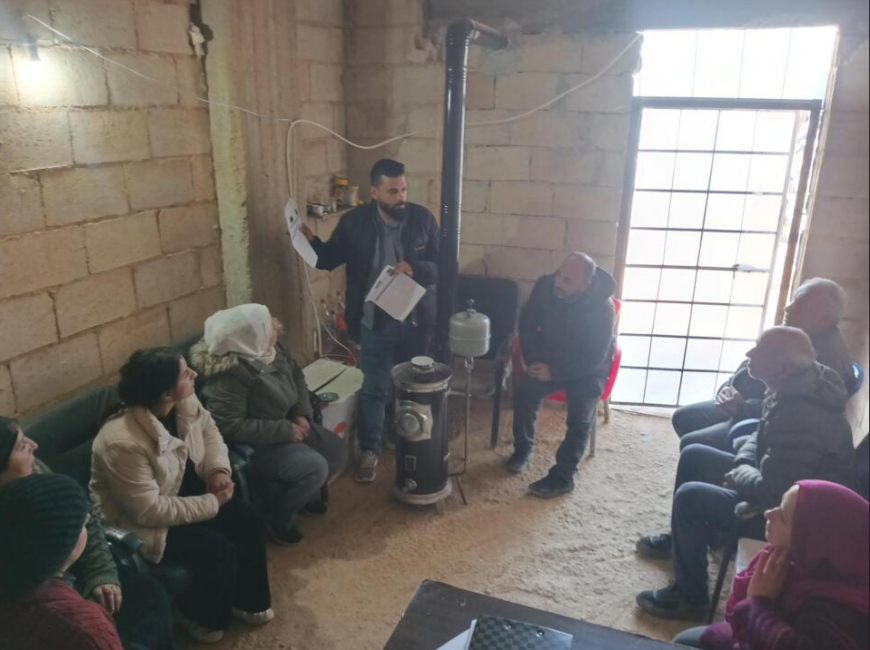
Tabqa informal settlement’s community-based protection initiative ensures the voices of disabled people are heard
Acted’s Community-Based Protection programme aims to enhance the safety, dignity, and inclusion of IDPs by addressing protection risks and strengthening the capacity of community representatives to support those around them. Through this initiative, Acted has supported the repair and replacement of damaged tents, installed solar lighting to improve safety within settlements, and relocated shelters to reduce exposure to flooding and water damage. The initiative has also provided protective equipment, installed fire extinguishers and fire blankets, and introduced dedicated entrances and queuing systems during distributions to ensure safer and more accessible services for pregnant women, older people, and persons with disabilities.
As part of this initiative, Ahmedparticipated in capacity-building training designed to empower community leaders. He received specialised training in community protection, practical firefighting, effective communication, and basic reporting skills. These trainings strengthened his ability to respond to emergencies and contribute to a safer living environment for everyone in the settlement. The skills Ahmed gained not only improved his community’s overall preparedness and resilience to risks, but also helped to brake stereotypes about disability. Instead of deterring him, his disability reinforced his commitment to supporting others facing similar challenges.
Ahmed worked closely with the Camp Administration and the Community-Based Protection Committee to improve service delivery, share critical information, and ensure that community needs were identified and addressed in a timely manner. Through his commitment and leadership, Ahmed played an active role in strengthening protection and inclusivity within his community.
Overall Acted’s approach to Community-Based Protection aims to empower local community members to take on leadership roles, strengthening their self-confidence and accurately voicing the concerns of their community. This model empowered Ahmed to support his community and act as a representative of vulnerable groups in Tabqa informal settlement.
Names have been changed to protect individuals’ privacy.