In Somaliland, recurrent drought and climate shocks have severely disrupted livelihoods, leaving agro-pastoral communities struggling to sustain their income and food security.
The women of Burao had watched the drought take almost everything, the animals, harvests, plans they once had. What it could not take was the decision to sit together, save together, and rebuild.
Acted, in consortium with Welthungerhilfe (WHH) and Candlelight, implemented a 30-month project titled Systemic Climate-Change Resilience for Food, Fodder and Water Security for Vulnerable Communities in Burao, Somaliland from November 2023 to May 2026 as part of the EU funded BREACH (Boosting Resilience and Adaptation to Climate Change) programme. The project aimed to support the resilience of the ecosystems in Burao district by supporting sustainable land management, climate-smart agro-pastoral practices, and improved access to water. As part of the consortium, Acted reached 435 households (2,610 people) across the villages of Booraamo, Kabadheere, and Qoyta in Burao District, Togdheer Region. Through the EU-funded BREACH programme, the project brought women together in Self-Help Groups, trained them in literacy, business, and financial skills, and supported land restoration, giving agro-pastoralist families practical tools to grow food, save money, and plan ahead.
Supporting communities through locally-driven interventions
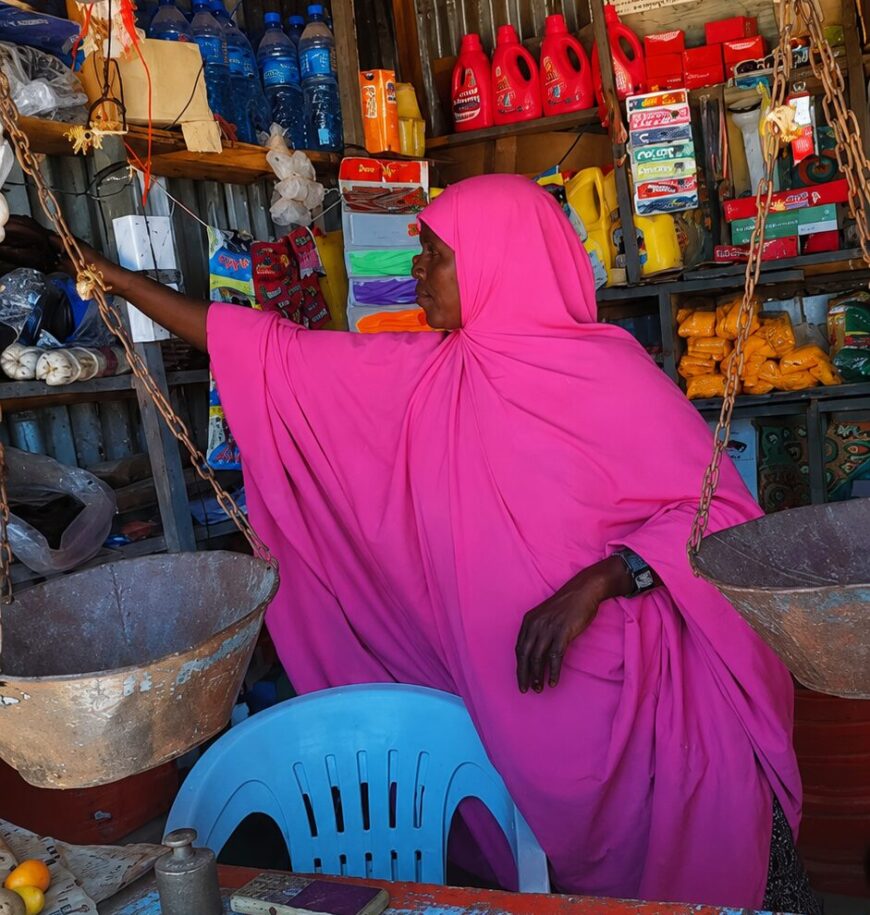
Restocking her small shop in Qoyta, on the road to Burao, a local entrepreneur continues to grow her business with the support of a startup grant from ACTED’s EU-funded BREACH programme.
For years, the families of Burao’s Togdheer region have lived under the weight of recurring drought. Season after season, failed rains have stripped agro-pastoralist communities of their livestock, their harvests, and their ability to plan ahead. By late 2025, Somaliland had declared a national drought emergency, appealing for help for one million people. In Togdheer, water sources dried up and pastureland disappeared. By early 2026, the number of Somalis facing Crisis-level food insecurity had nearly doubled to 6.5 million, with agro-pastoral communities among the hardest hit. Women heading households alone carried the heaviest load.
Self-Help Groups (SHGs) are a culturally accepted saving mechanism that builds financial independence, resilience, and mutual support. Each group decides on a specific amount to contribute to savings on a weekly basis. In Somali and Somaliland contexts, SHGs closely align with traditional community-based support systems such as Ayuto, a rotating savings practice rooted in trust, kinship, and collective responsibility. This cultural familiarity makes SHGs especially effective: rather than introducing something foreign, the programme builds on existing social norms of cooperation and mutual aid that communities already understand and practise.
Through the EU-funded BREACH programme, Acted established three Self-Help Groups (SHGs) across Burao District, bringing together 60 women, 20 per group, selected through clearly defined eligibility criteria targeting the most vulnerable agro-pastoralist households. Over six months, Acted staff facilitated two structured training modules: capacity building for women’s self-help groups, and basic financial management and income generation. Local teachers, trained by external consultants following the Caritas curriculum, led sessions on the ground. Women saved collectively on a weekly basis, pooling contributions into group accounts and community bank holdings, building not just skills, but financial habits and mutual accountability that could outlast the project.
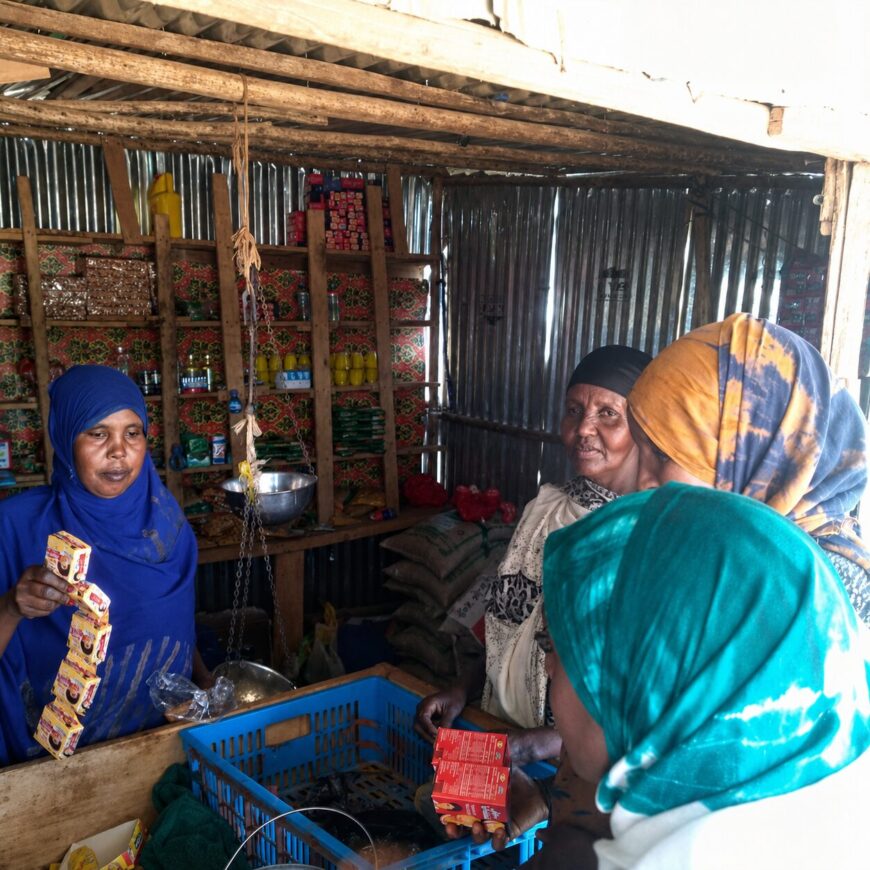
Running a small shop in Boorama village, a local entrepreneur developed her business with the support of a startup grant from Acted’s EU-funded BREACH programme.
Before the programme came to Booramo, she knew what it meant to watch a season fail. The rains would not come, the animals would thin, and the options would narrow. She had no savings, no formal skills, and no clear way forward for her household. When she joined the Self-Help Group, she showed up every week for six months, through the heat, through the household pressure, through the drought that did not pause for anyone. She learned to read numbers, to track money, to trust a savings box with her neighbours. Slowly, something shifted. Not just in her account balance, but in how she carried herself. When the training ended, a startup grant made the next step possible. Today, she runs a small shop in Booramo. Every item on that shelf is something she chose, priced, and sold herself.
Your efforts have empowered us, strengthened our confidence, and created permanent change. As our community's first SHG initiative, it has been truly transformative.
With the generous support of the European Commission through the BREACH programme, Acted has empowered 60 women across three villages in Burao District, equipping them with the financial literacy and business skills needed to rebuild their livelihoods in the face of recurring drought. SHG members can now save, plan, and support one another as a network of women entrepreneurs.