Cash assistance has become a vital tool for strengthening dignity and choice in crisis-affected communities. In Kennya, Acted provides unconditional cash support to refugees and host communities facing displacement and limited access to services.
Among them is Grace Kelei* who shares her experience of life in Kakuma refugee camp, and how this support has helped her family meet essential needs while maintaining a sense of agency and hope.
As lead of the Kenya Cash Consortium (KCC), Acted is providing life-saving support to crisis-affected refugees and host communities across Kenya through Multipurpose Cash Assistance (MPCA). Launched in 2024, with the support of the European Union (DG ECHO) the program addresses the critical needs of vulnerable households affected by disasters in the Arid and Semi-Arid Lands (ASALs) and in the Kakuma and Dadaab refugee camps.
The Kenya Cash Consortium brings together Acted, Oxfam, Concern, and the Asal Humanitarian Network (a network of more than 30 humanitarian actors working in the ASALs). Since March 2024, more than 32,000 individuals have already been reached, receiving critical assistance that helps families to stabilise, recover, and rebuild their lives.
Grace and her family’s reality
Grace Kelei, a 44-year-old South Sudanese woman, arrived in Lokichogio, in Turkana, Kenya, in April 1994, escaping conflict in South Sudan. After she was shot, she had to flee for her life, leaving her family behind. After arriving in Lokichogio, she was able to receive treatment for her gunshot injuries with the support of humanitarian actors. In August 1994, she relocated to Kakuma, where she has remained since. Years later, she learned the devastating news that her mother, whom she had not seen since, had suffered the same fate and ultimately succumbed to her injuries. Today, she remains fearful of returning to South Sudan, convinced that her life would be at risk.
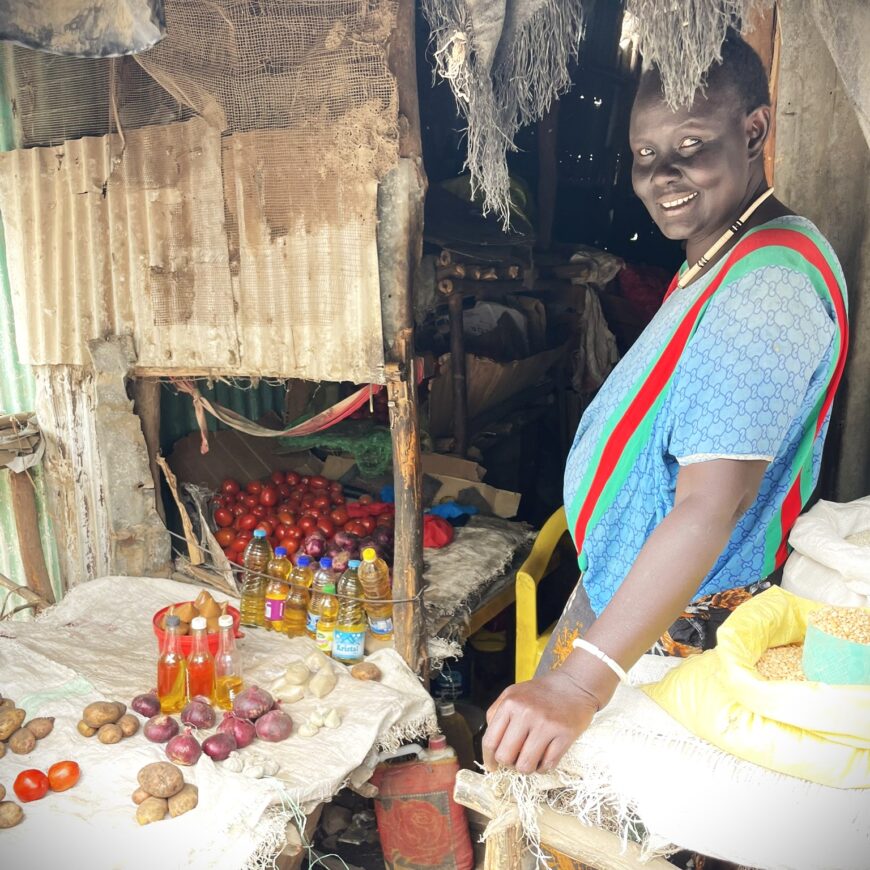
Grace met her husband in Kakuma, and together they have 8 children, and 4 grandchildren. Her husband is unemployed, as are her adult children, and they all live in the camp. She runs a small grocery shop, but the earnings are far from enough to cover the family’s needs. As an unregistered refugee, Grace is not eligible for support from existing actors and cannot access medical services among other challenges. Although several attempts have been made to initiate her registration, the process has never been completed. She hopes to leave the camp one day, hopefully to start afresh in South Sudan.
Without an alien card, Grace and her family constantly face food insecurity. They have often been forced to adopt difficult coping strategies, such as setting aside food exclusively for the children, or reducing portions so the family survives on a single meal a day. Full registration registered would enable her to legally open a business, receive a SIM card, and move freely in Kenya. For now, benefitting from Multi-Purpose Cash Assistance has offered an avenue for relief, including supplementing the food assistance the family receives, and allowing Grace to continue running her small enterprise.
Grace’s Cash Aid Journey
Grace learned about the cash assistance project during one of Acted’s community mobilisation exercises in Kakuma camp with a local implementing partner, LOKADO. She was informed about the type of assistance she would receive, the number of cycles, the source of funding, the targeting criteria and her eligibility. Following her selection as a beneficiary under the project, LOKADO set up a bank account for her using her partial registration details. She used the first two cycles to buy staple food items for the family, as well as stock up the small shop, carefully managing the income to ensure it would last until the next cycle. In total, Grace will receive four cycles of cash assistance over four months.
A day in Grace's life
Each morning, Grace rises early and quietly prepares herself for the day ahead. By 7 a.m., she’s at her grocery shop, ready to welcome customers. Usually, her children go without breakfast. The younger ones benefit from a school feeding program that provides lunch, while the older children and other family members manage with just one shared meal in the evening, which she prepares after closing the shop at 6 p.m. Food insecurity and limited access to medical care remain the most pressing challenges for the family. As undocumented refugees without alien cards, which are required for full medical assistance, her family is left vulnerable. Three of her children have received the card, but one child older than 18 is still waiting, like Grace, caught in a system they do not clearly understand. Through it all, Grace remains resilient, holding her family together with quiet strength and hope, making the most of any support she can receive. Receiving cash assistance from Acted, under the KCC project, has allowed Grace and her family to meet some of their most immediate needs, and is a source of hope for their future.
This project has allowed me to sustain myself and avoid many pressing survival challenges.
For Grace and her family, receiving cash assistance has been more than just financial support; it has provided stability, relief, and a renewed sense of possibility. By covering essential needs and enabling small-scale income generation, the project allows families like hers to navigate daily challenges with greater confidence. Stories like Grace’s highlight the tangible impact of flexible cash support in helping displaced and vulnerable communities regain control over their lives and plan for the future.
*Names have been changed to protect individuals’ privacy