By 2026, Yemen remains locked in one of the world's most protracted humanitarian crises, with 23.1 million people (approximately 65.4 per cent of the population) requiring humanitarian assistance. A combination of conflict, economic and humanitarian factors aggravate this situation. In Marib governorate, north of Yemen, the population has grown from 340,000 to over 2 million since the outbreak of the conflict in 2015 as families flee both frontline conflict and devastating climate shocks. This growing urban pressure has pushed basic services to a breaking point, particularly in displacement sites. In overcrowded sites like Al-Hami IDP site, clean water is located approximately 3 kilometres away, which reduces access and increases exposure to protection risks for individuals responsible for water collection–usually women and children.
Water scarcity in Al-Hami
For years, residents of Al-Hami IDP site lived in a state of water scarcity. Families who had already lost their homes in Hajjah, Ibb, and Abyan found themselves facing a new challenge: the absence of a rehabilitated, local water source. This scarcity was compounded by limited funding and weakened operational capacity of water service providers.
Mohammed Abdo*, a 31-year-old father of twelve, reported that his children frequently returned home empty-handed after walking kilometres to a private water well, only to find it closed. He remembers:
My children did not arrive during the time allowed for displaced people to fill their water containers. When they reached the water source, the owner had already closed it, and everyone else had finished filling their containers. My children returned home without any water. All day, we had no water for household use, bathing, or cooking.
These long walks were dangerous, exposing women and children to significant protection risks on remote, unsupervised paths.
Samah Sharif*, a mother and community leader who fled Hajjah in 2018, recalls the difficult choices families had to make. With only two small containers of water secured after hours of waiting, mothers often had to decide whether to use the water for cooking a basic meal or for maintaining the hygiene necessary to prevent disease.
Sometimes we had to skip washing or cooking properly because there was not enough water for everyone.
Restoring Dignity Through Infrastructure
To improve the situation, thanks to the European Union, Acted implemented Community-Based Projects designed to link site development with strengthening the community’s self-reliance. Members of the Al Hami site’s community took leadership in identifying water scarcity as a priority need through a focus group discussion and developed a response plan with support from Acted. Based on the community-based response plan, Acted supported the construction of a large-capacity water tank, the installation of a pipeline network, and the establishment of four strategically located distribution points within the residential areas. The projects were led by skilled and community-based workers. By bringing the water source to the community, the intervention aimed to restore both time and safety to the lives of over 740 residents of Al-Hami IDP site.
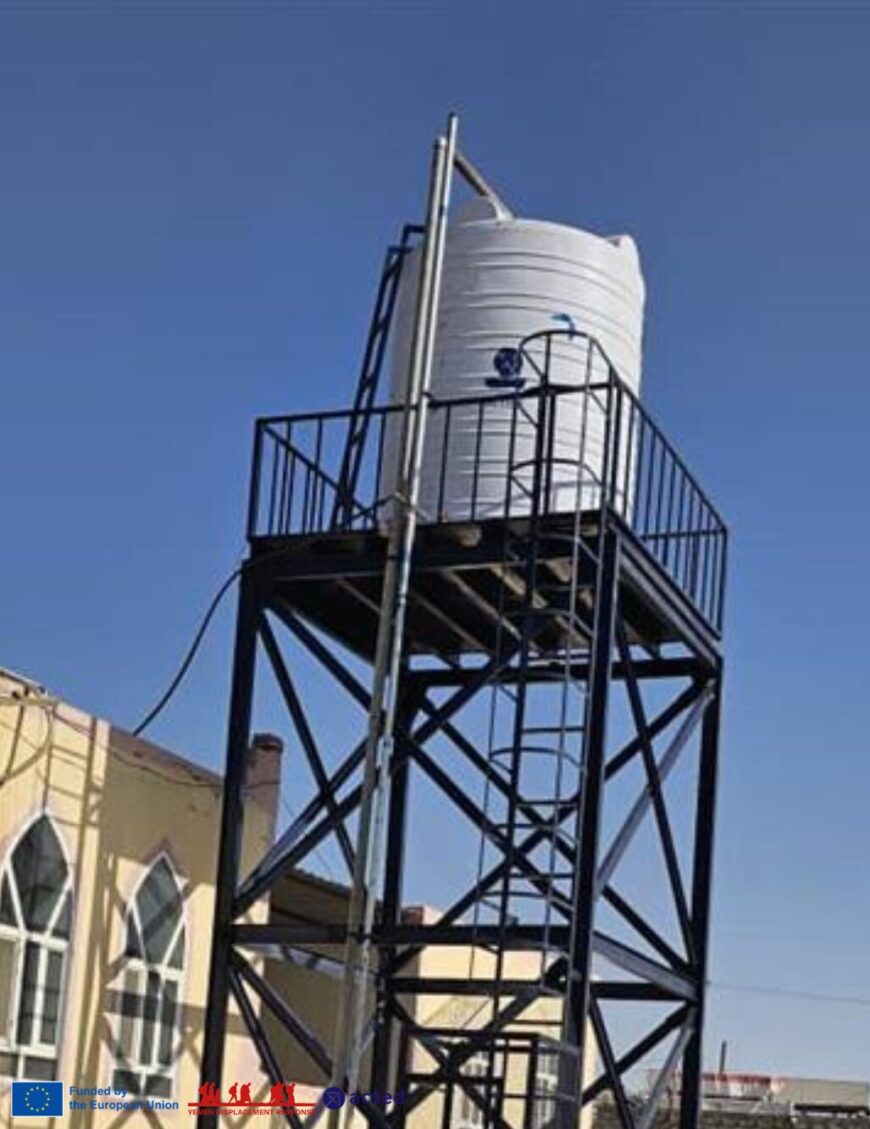
Metallic water tank tower, Al Hami IDP site, Marib Al Wadi district, Marib governorate, December 2025
The impact of the new water system has been transformative for Al Hami site’s community. For Mohammed Abdo, the primary relief is the safety of his family.
Now the water is inside the camp, and we feel safe, When water is nearby and available, families can live with dignity and peace.
As a community committee member, Samah Sharif sees a future where access to water is no longer a challenge at Al Hami site. The availability of water for cleaning, cooking and bathing has not only improved health but has also brought a sense of stability and security to the community.
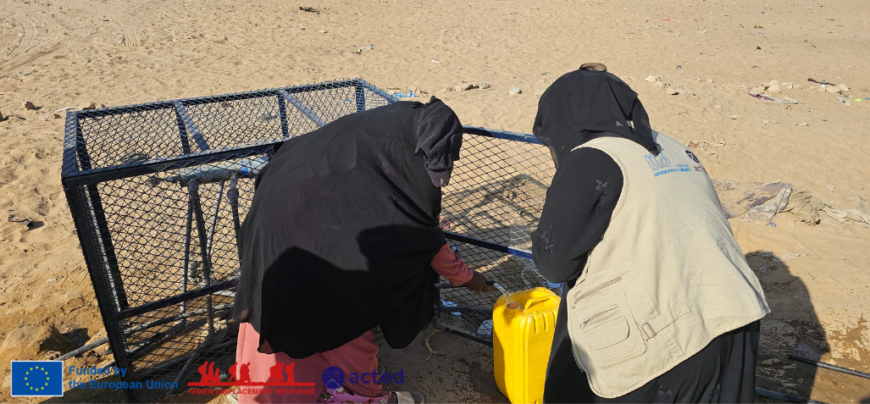
A beneficiary filling a water Jerry can from one of the water distribution points, Al Hami IDP site, Marib Al Wadi district, Marib governorate, December 2025
As part of the project “Improving living conditions and supporting durable solutions for displacement-affected communities across Yemen”, funded by the European Union through its Humanitarian Aid Operations and delivered in partnership with the Yemen Displacement Response Consortium, Acted provides a comprehensive package of assistance. This includes site management, flood preparedness, shelter and essential non-food items, water, sanitation and hygiene (WASH), and protection services, reaching over 88,908 people across Marib, Aden, Al Dhale’e, Hodeidah, Abyan and Saadah, to help restore stability and dignity.
*Names of beneficiaries have been changed to protect their privacy.